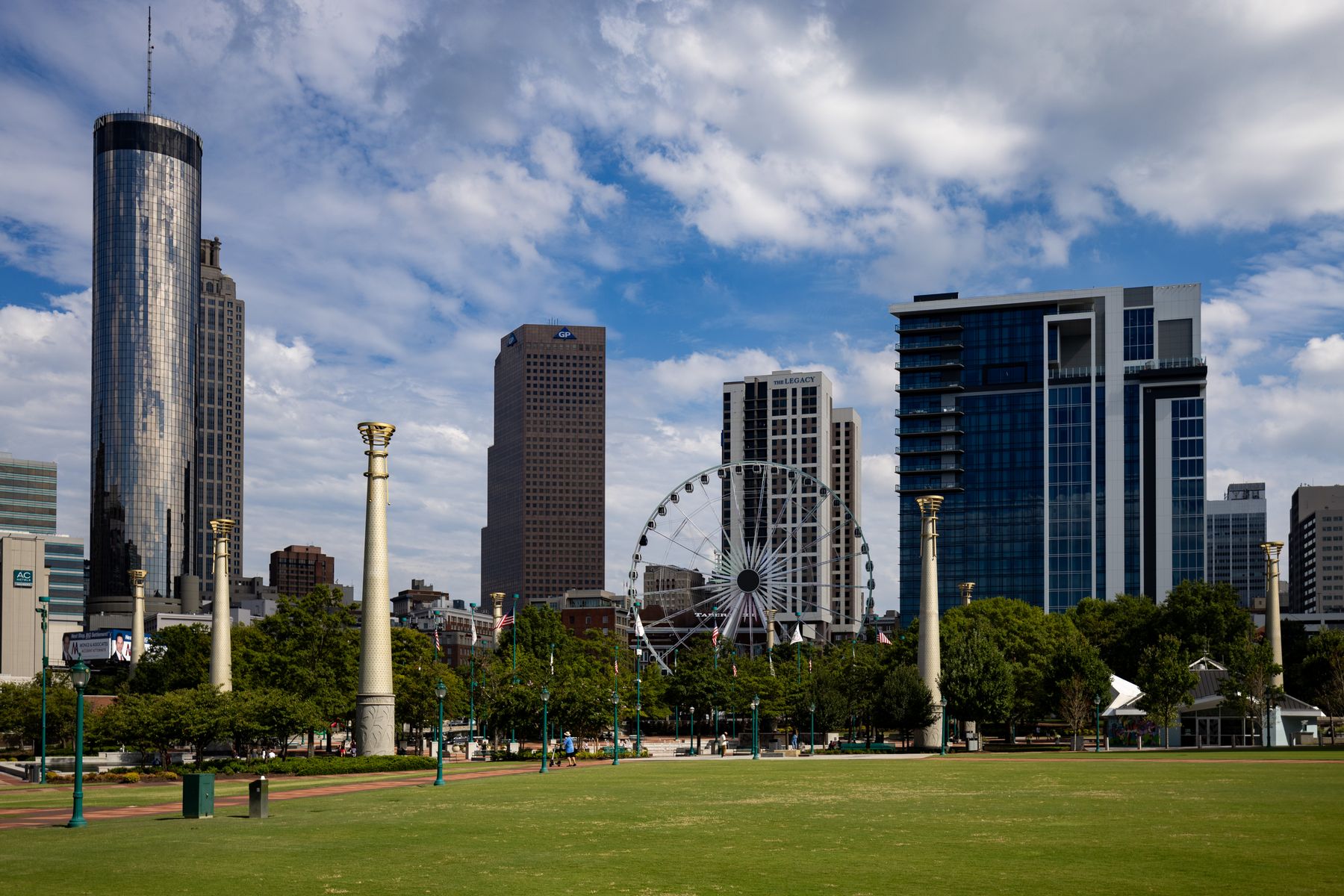
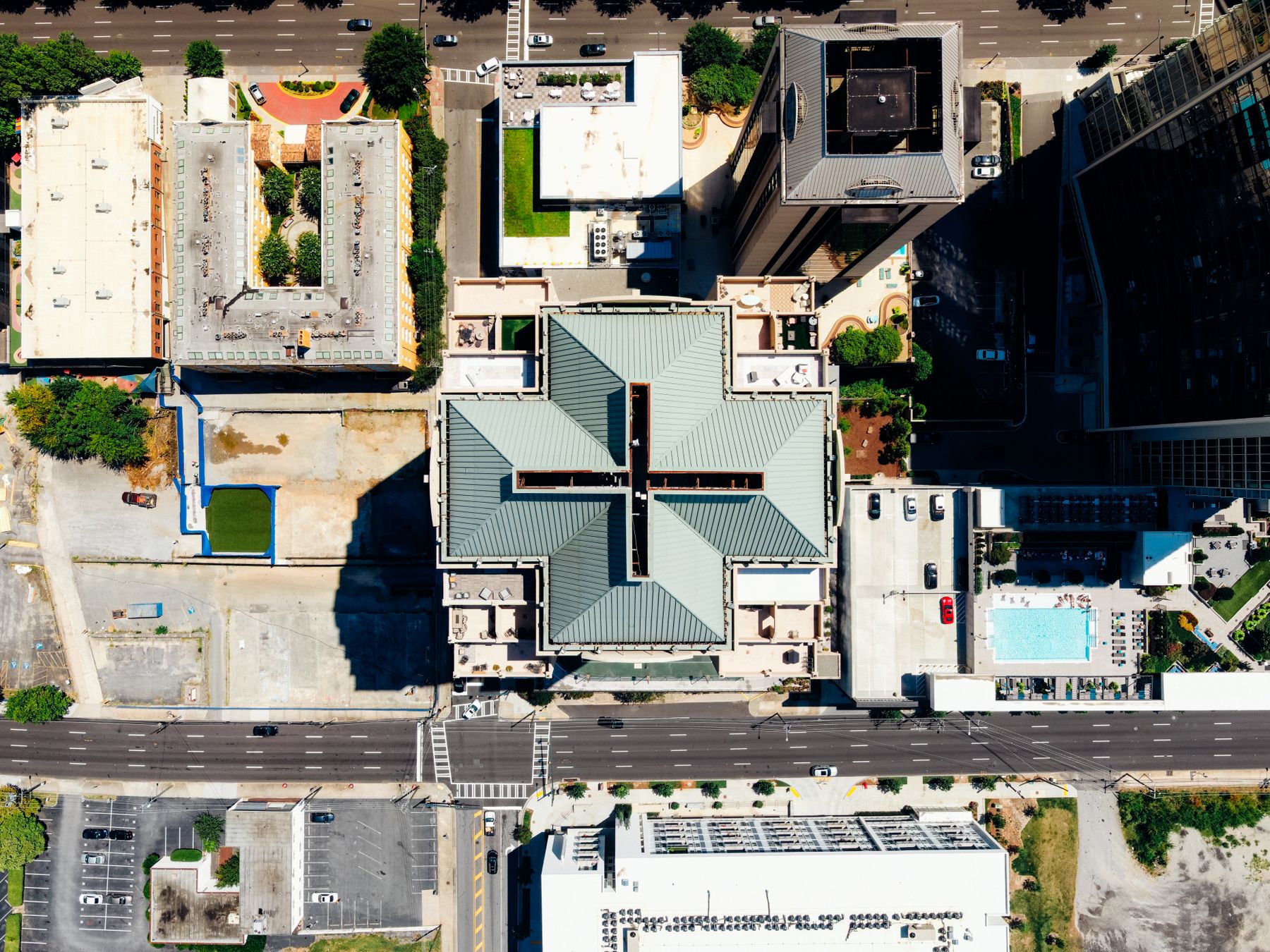
Fairlie-Poplar, bounded roughly by Peachtree, Marietta, Fairlie and Broad streets, holds one of the densest clusters of early twentieth-century commercial buildings in the Southeast. Walk Broad Street between Walton and Poplar for the best concentration, then cut through Woodruff Park toward the Candler Hotel, a 1906 Beaux-Arts tower converted to lodging. Downtown rooms typically run $150 to $260 a night, less on weekends when business travel drops off. You are two blocks from the Peachtree Center MARTA station, which puts you at Hartsfield-Jackson in about 20 minutes without a car.
Downtown and the Fairlie-Poplar District
Fairlie-Poplar, bounded roughly by Peachtree, Marietta, Fairlie and Broad streets, holds one of the densest clusters of early twentieth-century commercial buildings in the Southeast. Walk Broad Street between Walton and Poplar for the best concentration, then cut through Woodruff Park toward the Candler Hotel, a 1906 Beaux-Arts tower converted to lodging. Downtown rooms typically run $150 to $260 a night, less on weekends when business travel drops off. You are two blocks from the Peachtree Center MARTA station, which puts you at Hartsfield-Jackson in about 20 minutes without a car.
The trade-off is evenings. Office workers clear out by six and several blocks feel empty after dark, so keep to Peachtree Street and the hotel lobbies. I would book here for a two-night stay built around the National Center for Civil and Human Rights, the College Football Hall of Fame and a show at the Tabernacle. Skip the souvenir shops along Underground Atlanta's upper level, which have thinned considerably. For a longer trip, Downtown works better as a base for transit than as a place to wander at night.
Sweet Auburn and the Martin Luther King Jr. National Historical Park
Sweet Auburn Avenue runs east from Downtown through the neighborhood that anchored Black Atlanta's business life from the 1920s onward. The National Historical Park is free and covers the King birth home, Ebenezer Baptist Church and the Eternal Flame, all within a few flat blocks. Auburn Avenue's commercial buildings, including the Odd Fellows Building and the Herndon Home, reward a slow walk. Budget 90 minutes at minimum; the birth home tour requires a timed reservation through the park service and fills quickly in January and February around the King holiday.
Lodging is thin inside the district itself. The nearest cluster sits along Courtland Street and Piedmont Avenue, a 15 to 20 minute walk or a five minute rideshare, with rates generally $130 to $220. The Atlanta Streetcar once linked this area to Downtown, but check current service before relying on it. I would stay two or three blocks west and walk in early, around 9am, before tour groups arrive. Skip driving and parking on Auburn; the streets are narrow and the lots are limited.
Inman Park and the Atlanta BeltLine Eastside Trail
Inman Park, laid out in 1889 as Atlanta's first planned suburb, has the best residential walking in the city. Start at the Inman Park/Reynoldstown MARTA station and follow Euclid Avenue past Victorian and Craftsman houses, then drop to the BeltLine Eastside Trail near Krog Street Market. The trail runs about 2.5 miles north to Piedmont Park, flat and paved, busy with cyclists on weekend afternoons. Spring, roughly late March to May, is the season here: the dogwoods and azaleas are out and the porches are worth the detour.
Hotels are scarce and expensive in the immediate blocks; expect $200 to $320 for the few boutique properties near Krog Street, and book well ahead for spring weekends. A cheaper approach is a hotel in Old Fourth Ward along Ponce de Leon Avenue, $150 to $230, which puts you a 10 minute walk from the trail's midpoint. I would choose Old Fourth Ward for a first Atlanta trip: you get the BeltLine, the market and easy access to Midtown, all without a car. Skip the trail after dark south of Krog Street, where lighting is patchy.
Midtown, Ansley Park and Getting Around
Midtown's historic core around Peachtree Street between North Avenue and 10th Street mixes 1920s apartment buildings with the High Museum and Piedmont Park's north edge. Ansley Park, just north of Pershing Point, is a quiet 1904 streetcar suburb of curving roads and small parks, best walked on a weekday morning. Midtown hotel rates run $170 to $300, spiking during major convention weeks and when the Atlanta Jazz Festival takes over Piedmont Park each May. The Arts Center and Midtown MARTA stations give you direct rail to the airport and to Downtown in under 15 minutes.
For a three-night trip I would split the stay: two nights in Midtown or Old Fourth Ward for walkability, one night Downtown if you have an early flight or a downtown event. Drive times matter here — Buckhead to Sweet Auburn is roughly 20 minutes without traffic but 45 in rush hour, so do not plan cross-city hops between 7 and 9am. Skip rental cars unless you are leaving the city; MARTA plus rideshares covers all five districts for less than parking alone.
"Atlanta's Historic Neighbourhoods: Where to Walk, Where to Sleep" was written by the people who run AirFair Atlanta and is published as they wrote it, in October 2026. It is in 4 parts: Downtown and the Fairlie-Poplar District, Sweet Auburn and the Martin Luther King Jr. National Historical Park, Inman Park and the Atlanta BeltLine Eastside Trail and Midtown, Ansley Park and Getting Around.
Read the method ↗